Airbnb house rules template: free Word and PDF, with examples
Airbnb house rules for UK and US hosts: 10 rules with example wording, quiet hours, pools and cameras, Airbnb’s new rules from 20 November 2026. Free Word and PDF.
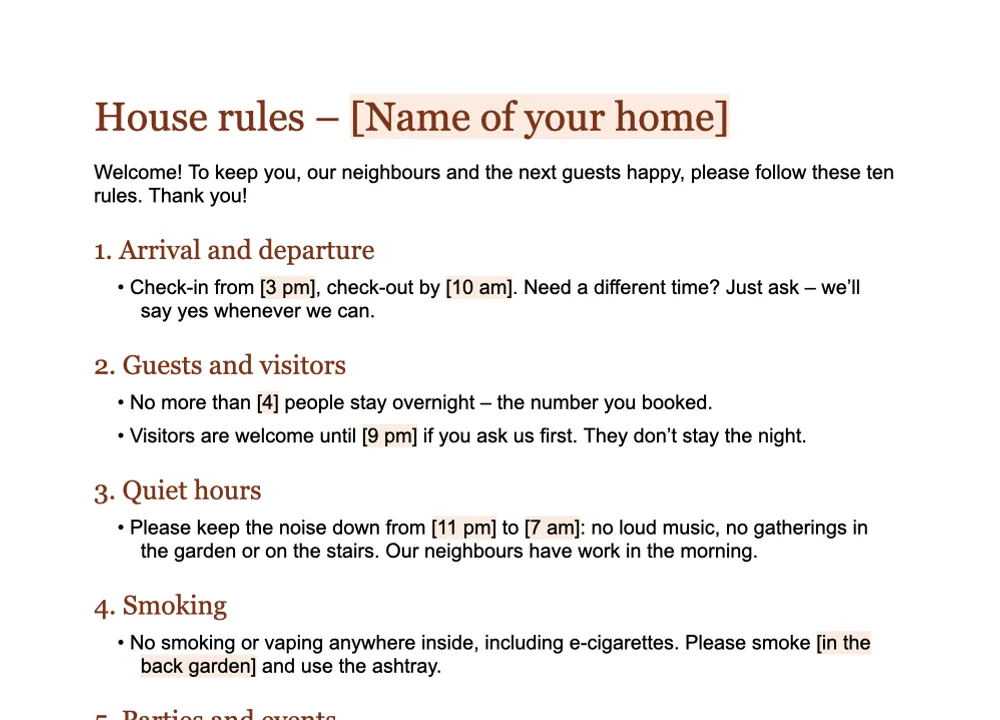
Good Airbnb house rules cover ten things: arrival and departure, guest numbers, quiet hours, smoking, parties, pets, bins and trash, keys and parking, damage and, in the UK, the guest details the law asks you to record. Below you’ll find example wording to copy, how to add the rules to your listing, Airbnb’s new rules from 20 November 2026 and a free house rules template in Word and PDF, no sign-up.
Download the house rules template (Word, free)
Download the house rules template (PDF, free)
What should Airbnb house rules include?
Ten points are enough. One or two sentences each, readable in ten seconds.
- Arrival and departure. Check-in from 3 pm, check-out by 10 am, plus “Need a different time? Just ask.”
- Guests and visitors. The number of people booked, and whether visitors may come round.
- Quiet hours. Actual times, not “please be considerate”.
- Smoking. Vaping, garden, balcony and deck included. Say where guests can smoke.
- Parties. A clear no.
- Pets. Yes, no or by arrangement.
- Bins, trash and recycling. Which bin for what, where they are, and bin day.
- Keys, doors and parking. Lock up, close the windows, call you before a locksmith, where to park.
- Damage. Report it straight away. No threats.
- Guest details (UK). What every guest aged 16 or over tells you on arrival.
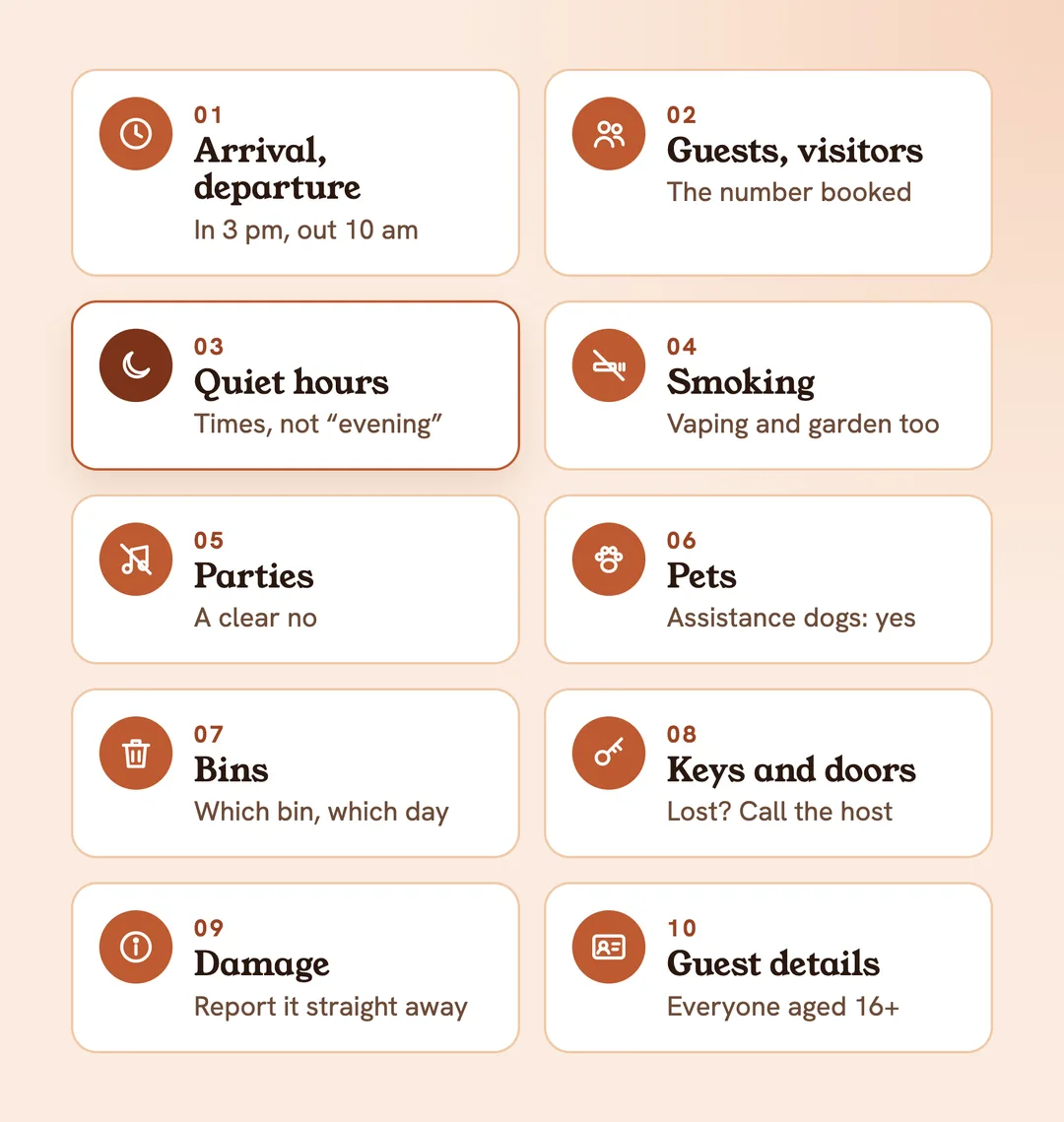
From our experience, three rules get broken most: guests forget to take the rubbish out, forget to switch on the dishwasher, and smoke on the balcony. What helps: a small “no smoking” sign on the balcony and the same line in every listing, and a reminder about the bin and the dishwasher the evening before checkout. The questions guests ask most are just as predictable: which floor and which door, where to park, where the bins are, can they arrive early or leave late. Answer them in the rules and you get fewer messages.
Point 10 is UK law, not a favour: in a home let for money, every guest aged 16 or over gives their full name and nationality on arrival, and guests who aren’t British, Irish or Commonwealth citizens also give their passport number and place of issue. You keep the record for 12 months. How that works without a key handover: Airbnb self check-in. There’s no such national rule in the US, so delete point 10 there.
Example house rules to copy
House rules don’t have to read like a sign at the swimming pool. Say why the rule exists and guests are more likely to follow it.
- Instead of “Strictly NO smoking!”: “Please don’t smoke inside or in the garden by the door. There’s an ashtray at the back.”
- Instead of “Quiet after 10 pm!!!”: “Our neighbours get up early for work, and the walls are thinner than you’d think.”
- Instead of “Lost keys = $150 fine”: “Lost the key? Call us before a locksmith. It’s cheaper for everyone.”
- Instead of “All damage will be charged”: “Something broke? Tell us straight away and we’ll fix it before the next guests arrive.”
- Instead of “Park anywhere”: “One car on the driveway, please. The spot in front of the garage belongs to our neighbour.”
Want a sign? The template prints on two A4 pages; the PDF is ready to print, and Word lets you change every sand-coloured field first.
How do you add house rules to your Airbnb listing?
On a computer: Listings → choose the listing → Listing editor → House rules. Under “Standard house rules” you set pets, events, smoking, quiet hours, maximum overnight guests, commercial photography and lock-up at checkout. Everything else goes under “Additional rules”, either “During the stay” or “Before checkout” (Airbnb Help Center). Guests see the rules on the listing, in the booking terms and in automated emails.
Booking.com shows house rules on the property page and during booking, and guests must agree to them to complete the reservation (Booking.com for Partners).
Airbnb’s new house rules policy from 20 November 2026
For reservations booked on or after 20 November 2026, Airbnb’s “Reasonable house rules” policy applies (Airbnb Help Center). In short:
- Rules live in the House rules section of the listing at the time of booking. A new rule sent by message, written on a sign in the home or said at the door doesn’t count.
- No fines or penalties. “£100 for smoking” is out.
- No separate contracts or ID, unless the law requires them, as UK law does for the guest details in point 10.
- No heavy checkout chores. Airbnb’s examples: stripping the beds, taking the trash off-site, washing and putting away dishes.
- No rules that contradict the listing. If the listing shows a pool, a rule can’t close it.
So the sheet on the wall is a reminder, not the contract. Write the same rules as in the listing, never stricter or new ones. If you let a flat or a condo, read your lease and the building’s or HOA’s rules too: if they set rules for noise, bins or shared areas, copy them into the listing word for word.
Quiet hours: what does the law say?
UK. In England, Wales and Northern Ireland, the Noise Act 1996 treats 11 pm to 7 am as night hours: the period when the council can act on complaints of excessive noise from a home (Noise Act 1996, section 2). Scotland has its own rules; ask your council.
US. There’s no national rule. Quiet hours come from your city or county noise ordinance, and from HOA or condo rules if you have them. Look up your local code and use its times; the template suggests 10 pm to 7 am as a starting point.
Rules for houses: pool, hot tub, grill and cameras
A flat needs ten rules. A house with a garden often needs three more, and the template has them as optional blocks:
- Pool and hot tub. Opening hours, children only with an adult, no glass, no diving.
- Grill or barbecue. How to turn it off (the gas valve, not just the knob) and where not to use it.
- Cameras and noise monitors. Airbnb has banned cameras inside the home since 30 April 2024, even switched-off ones. Outdoor cameras, such as a doorbell camera, are allowed if the listing says where they are. A noise monitor indoors is allowed if you disclose it and it isn’t in a bedroom, bathroom or sleeping area (Airbnb Help Center). Say the same in the house rules: guests ask.
Deposits, fines and damage: what actually works
Many templates online still threaten fines: $200 for smoking, $100 for a party. On Airbnb they’re no longer allowed for bookings from 20 November 2026, and they were hard to collect before. What works:
- Document damage. Photos, quotes, receipts. On Airbnb, send a reimbursement request within 14 days of the guest’s checkout. If the guest doesn’t pay, Airbnb reviews it under host damage protection, which covers extra cleaning such as smoke odour removal (Airbnb Help Center). We had exactly this: a guest didn’t answer our request for money, we passed it to Airbnb support, and the damage was paid as a claim through the platform.
- Rules guests accepted when booking. A guest who booked a “no smoking” home can’t claim they didn’t know.
- Parties. Airbnb itself bans open-invite parties and disruptive gatherings, whatever their size (Airbnb Help Center), so your “no parties” rule has the platform behind it.
- Don’t turn away assistance dogs. Guests with a service animal can stay even if pets aren’t allowed, without pet or extra cleaning fees; in California and New York the same applies to emotional support animals (Airbnb Help Center). The template already says: “Assistance dogs are always welcome.”
Paper or digital house rules?
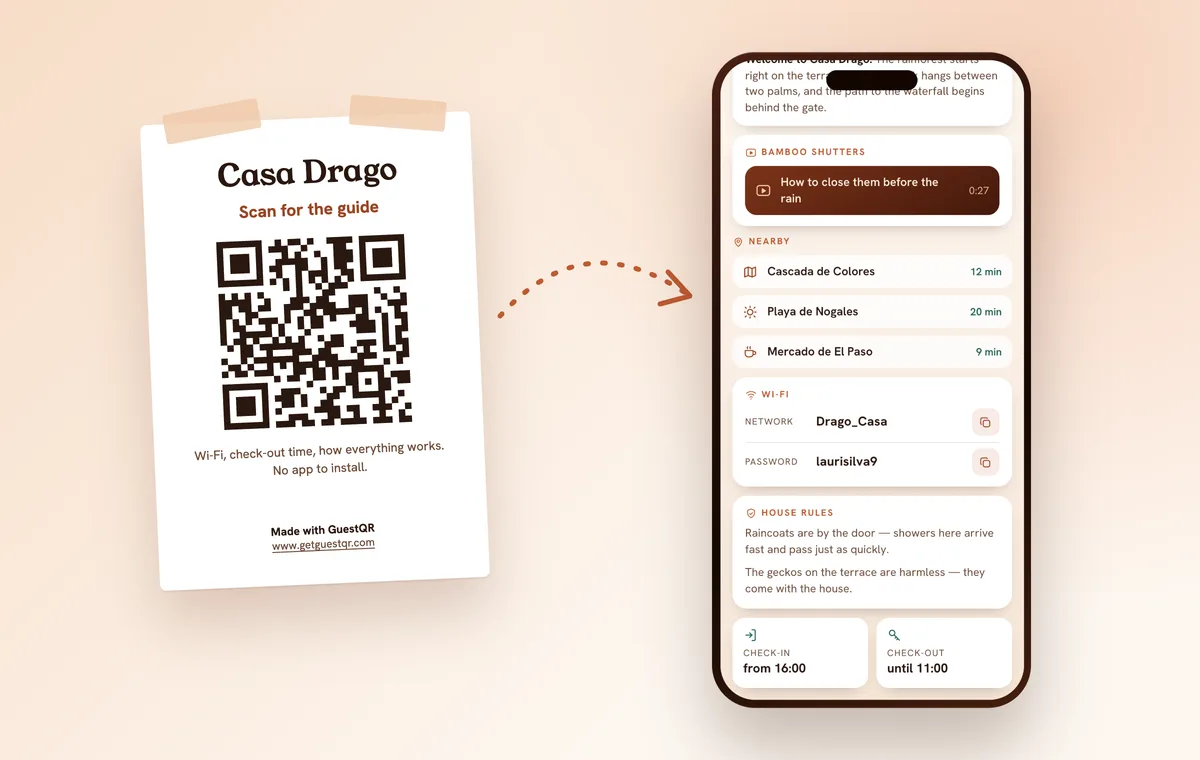
On paper: print the template, frame it by the door and put a copy in your welcome book. American hosts call it the house manual.
With GuestQR, the house rules sit in a digital welcome book: paste the link to your Airbnb or Booking listing, fill in the rules and print a QR poster for the wall of your home. Guests scan the code and read the rules on their phone – in their own language, one of eight, no app needed. Quiet hours or bin day change? You update it in a minute; the sheet on the wall would need reprinting.