Airbnb registration and licence rules: Scotland and the UK (2026)
Airbnb rules in Scotland, Wales, Northern Ireland and England: who needs a licence or registration number, what it costs, the deadlines and the new visitor levy.
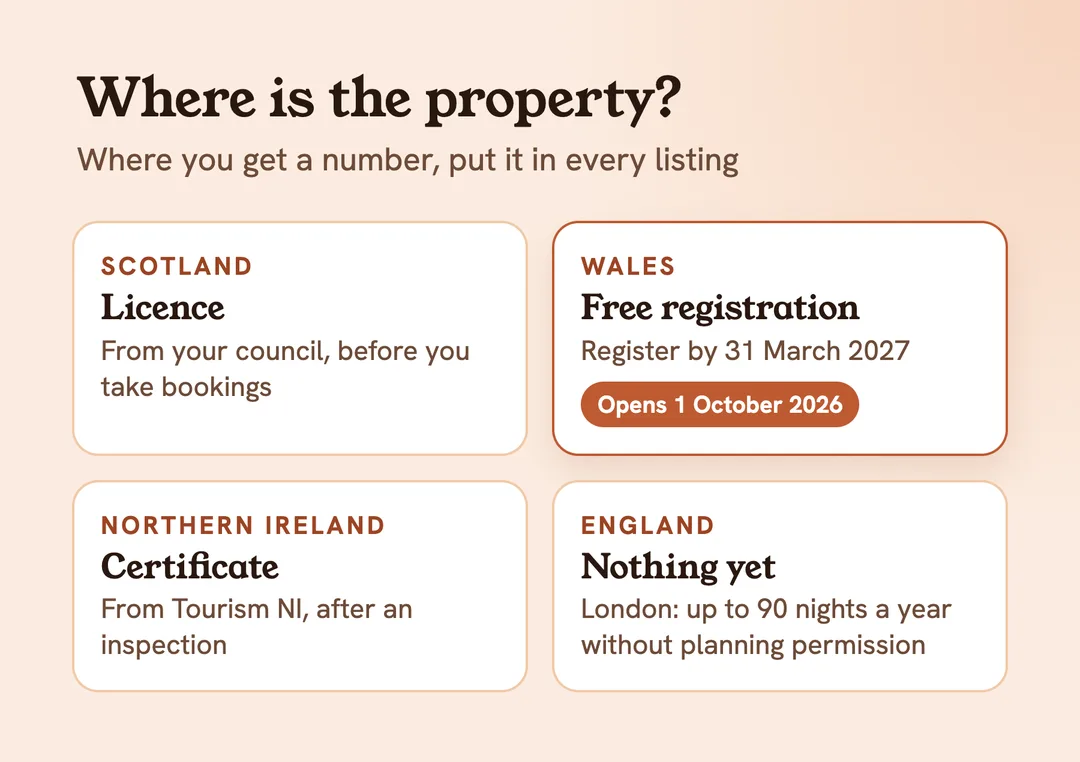
It depends on where the property is. Scotland needs a short-term let licence. Wales opened a national register on 1 October 2026. Northern Ireland needs a Tourism NI certificate. England has no register yet: it is now expected in March 2027, and in London you can let a home for up to 90 nights a year without planning permission. Where you get a number, put it in every listing.
Here is what each nation asks for, what it costs and what to write in your listing.
Do you need a licence or a registration number?
| Where | What you need | Deadline or status |
|---|---|---|
| Scotland | Short-term let licence from your council | Before you take bookings |
| Wales | Free registration with the Welsh Revenue Authority | Open since 1 October 2026, register by 31 March 2027 |
| Northern Ireland | Tourism NI certificate after an inspection | Before you offer the property |
| England | Nothing yet: a national register is planned | Expected March 2027 (GOV.UK, October 2026) |
Scotland: the short-term let licence
You must get a licence before you take bookings or receive guests (mygov.scot). It does not matter how often you let: one night a year needs a licence too. You apply on your council's website, each council sets its own fee, and a first licence usually lasts up to three years.
Which licence type do you need?
- Home sharing: you let part of your own home while you live there.
- Home letting: you let your own home while you are away, for example on holiday.
- Home letting and home sharing: both, at different times.
- Secondary letting: a property that is not your main home, such as a holiday cottage or a flat bought to let.
Not sure? The short-term lets checker on mygov.scot tells you whether you need a licence and which type.
What the property needs
The mandatory conditions are the same in every council (mygov.scot):
- the repairing and tolerable standards;
- a Gas Safety Certificate from the last 12 months, if there is gas;
- an Electrical Installation Condition Report and a Portable Appliance Testing (PAT) report, with tested items labelled;
- a fire risk assessment; heat, smoke and carbon monoxide alarms; furniture that meets the 1988 fire safety regulations, with labels, receipts or photos as proof;
- a legionella risk assessment;
- buildings insurance for the length of the licence and public liability insurance for each stay;
- an EPC from the last 10 years, if you let a whole house or flat.
The council and the Scottish Fire and Rescue Service set your maximum number of guests. Councils can add their own conditions and may ask for a simple floor plan or visit the property.
How to apply, and can neighbours object?
- Check the council's own conditions and fee on its website.
- Gather the certificates above and submit the application.
- Put up a site notice at or near the property for 21 days, then send the council a certificate that you did. A dated photo of the notice is useful proof.
- Wait for the decision. The council has 9 months; if it misses that deadline without a court extension, you get a licence for one year.
Neighbours, or anyone else, can object in writing, usually within 28 days. Safety, noise and nuisance count as grounds; disliking short-term lets in general does not (Scottish Government guidance). You get a copy of each objection and can answer it. If you are refused, you can appeal to the sheriff within 28 days, or apply again after a year.
Control areas: Edinburgh and Badenoch and Strathspey
A council can make a control area where short-term lets need planning permission. All of Edinburgh has been one since September 2022, and Highland Council added Badenoch and Strathspey in March 2024 (gov.scot). In a control area, you need planning permission, or a planning application already in, before you apply for the licence. Outside them, check with the council's planning department.
What guests must find inside the property
The licence also decides what you keep in the home. Guests must be able to reach:
- a certified copy of the licence and its conditions;
- fire, gas and electrical safety information, and copies of the gas, EICR and PAT reports;
- how to call the emergency services;
- what to do if the carbon monoxide alarm sounds.
How you do it is up to you: a notice board or a house folder works, and the guidance suggests sending digital copies with the booking confirmation too (guidance, section 5).
What goes in your Airbnb listing
Your licence number goes in every listing or advert, online or in print, together with the maximum number of guests and the EPC rating. Councils and platforms check that the numbers are real. Letting without a licence is a criminal offence: a fine of up to £2,500 and a one-year ban from applying.
New rules in 2026 and 2027: the visitor levy
Scottish councils can now charge a visitor levy on overnight stays, and short-term lets collect it like hotels (VisitScotland):
| Council | Levy | From |
|---|---|---|
| Edinburgh | 5%, first 5 nights | 24 July 2026 |
| Glasgow | 5%, whole stay | 25 January 2027 |
| Aberdeen | 7%, whole stay | 1 April 2027 |
| Stirling | 3% | 14 June 2027 |
| West Dunbartonshire | 5%, whole stay | 1 July 2027 |
The levy applies to bookings made months before the start date: in Edinburgh, to stays from 24 July 2026 booked from 1 October 2025 (City of Edinburgh Council). Dundee, Falkirk, Highland and Perth and Kinross are consulting until November 2026.
Wales: the visitor accommodation register
Since 1 October 2026, anyone who takes bookings of 31 nights or less in Wales must register with the Welsh Revenue Authority (GOV.WALES). That includes a spare room and your own home let once a year for a local event.
- Sign in with GOV.UK One Login.
- Add your contact details, the premises, the types of accommodation, when you take bookings, the number of bookable units and the maximum number of guests.
- Get your unique registration number.
Registration is free. Do it by 31 March 2027, even if your council does not introduce the visitor levy. After that, update your details within 30 days of any change; the WRA says updates open early next year. If you miss the deadline, the first penalty is £100 per premises, rising to £1,400.
Northern Ireland: the Tourism NI certificate
It is illegal to offer tourist accommodation in Northern Ireland without a certificate from Tourism NI (Tourism NI). An officer inspects the property; the certificate lasts four years. The fee is £40 per unit, at least £40 and at most £350.
England: is there an Airbnb registration number?
Not yet. The government is introducing a mandatory national register for short-term lets, and in October 2026 it moved the expected start to March 2027 (GOV.UK). Until it starts, there is no number to add.
In London, you can let a whole home for up to 90 nights per calendar year without planning permission, as long as the host pays council tax on the property (Deregulation Act 2015). Beyond that, you need planning permission from your borough.
Ready-to-copy lines
- Listing in Scotland: "Licence number: [your licence number] · EPC rating: [rating] · Up to [number] guests."
- Listing in Wales: "Registered visitor accommodation: [your registration number]."
- Welcome book: "This property is licensed by [your council], licence number [your licence number]."
- Welcome book, Scotland: "If the carbon monoxide alarm sounds: open the windows, turn off gas appliances, leave the property and call [emergency number]."
Copy the number from your licence or confirmation instead of retyping it: one wrong character, and the listing no longer matches your property.
The number in a digital welcome book
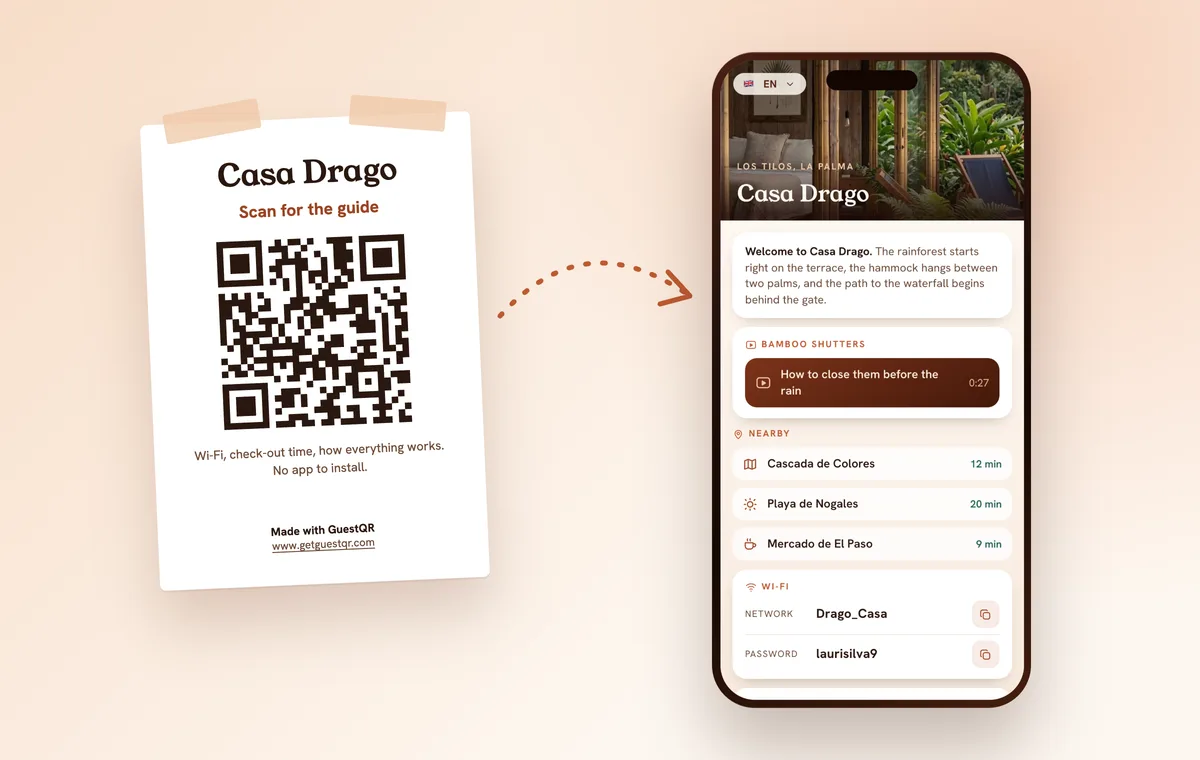
If your digital welcome book is on your guests' phones, the number fits in one line of the welcome text. In Scotland, the same guide can carry the safety information, the emergency number and the carbon monoxide steps, next to the paper copies in the house folder. With GuestQR, you paste your Airbnb or Booking link, finish the guide and print a QR poster for the wall inside the property: guests scan it and find the Wi-Fi, check-in, house rules and your licence number, with the text in their language, one of 8.